Delta-Neutral Calendar Spread Construction: A Practical Guide for Indian Index Options
In this article you will learn the basics of a delta-neutral calendar spread, see how to build one on NIFTY, BANK NIFTY or SENSEX, and understand the role of support and resistance zones in setting the strike levels. The guide uses clear, round numbers that are purely illustrative, so you can practice the logic without risking real money.
What it is
A delta-neutral calendar spread is an options strategy that balances the net delta of the position to be close to zero at initiation. It typically involves buying a longer-dated option and selling a shorter-dated option with the same strike. Because the two legs have different expiries, the time value component of the short leg decays faster, allowing the position to profit from the time differential while remaining largely insensitive to small price swings.
These are the two key reference points for choosing the strike of the calendar spread.
How traders read it (worked example)
Suppose NIFTY is at 24,000 today. A trader wants to construct a delta-neutral calendar spread that takes advantage of the time decay difference between the near-month and next-month expiry.
- Choose the strike – The strike should lie near a major level that the price has respected in the past. In the example above, 24,000 sits right at the center of the support zone and just below the VWAP.
- Buy the long-dated option – Buy a call at the 24,000 strike for the next-month expiry.
- Sell the short-dated option – Sell a call at the same 24,000 strike for the near-month expiry.
- Add a hedge if needed – If the trader wants to keep the delta exactly zero, a small adjustment with another option (e.g., a put or another call) can be made. For illustration, we will keep the position at zero delta by ignoring the small residual.
The payoff at expiry of the near-month leg is the negative of the payoff of the long leg, shifted in time.
The numbers 200 and 100 are hypothetical premiums. At a spot of 24,000 the long call is out of the money, so its payoff is zero. The short call at 24,200 is also out of the money, so its payoff is zero too, giving a net of zero. If the spot rises to 24,300, the long call gains 300, the short call loses 100, and the net payoff is 200. The shape is triangular, which is the hallmark of a calendar spread.
The figure below illustrates the open-interest distribution by strike for the same expiry. Notice the peak of call OI at 24,000 and the support from put OI on the other side. This distribution helps confirm that the strike is a respected level.
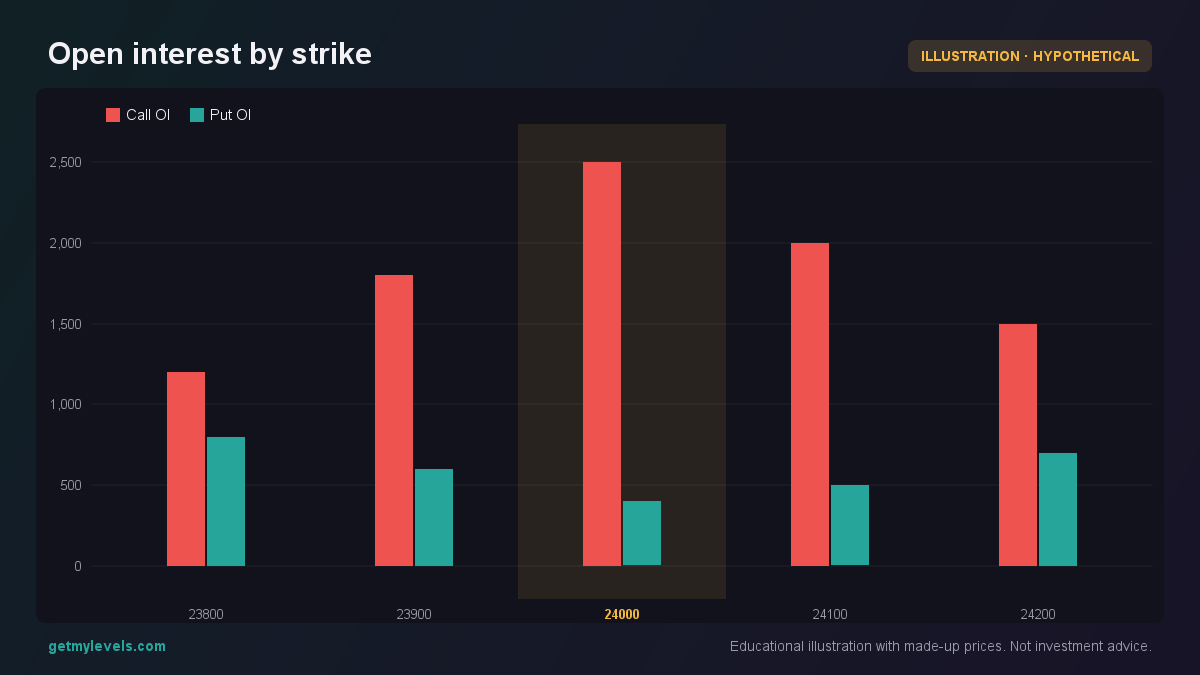 Figure 1: Call OI peaks at the chosen strike
The open-interest bars show that the 24,000 strike is where the market has concentrated activity. This concentration is a good sign that the strike will act as a support or resistance if the price moves.
Common mistakes
- Ignoring the delta – If the position is not close to zero delta, small price movements can offset the time-decay advantage.
- Choosing a strike far from a respected level – Picking a strike in a range with low activity may lead to poor liquidity and higher spreads.
- Overlooking the effect of volatility – A sudden spike in implied volatility can widen premiums and change the payoff shape.
- Neglecting the time decay of the long leg – While the short leg decays quickly, the long leg also loses value over time; the net benefit is only visible if the short-dated expiry is close enough.
Being aware of these pitfalls helps keep the strategy aligned with its theoretical benefit.
How it fits with support and resistance zones
Support and resistance zones are the building blocks for identifying the strike. A zone that the price has touched multiple times is a strong candidate.
In this example the price touched the support zone at 23,950-24,000, rebounded, and then moved toward the resistance zone at 24,100-24,140. A calendar spread built at the 24,000 strike would therefore have the support as a safety net and the resistance as a potential area where the long leg may become valuable.
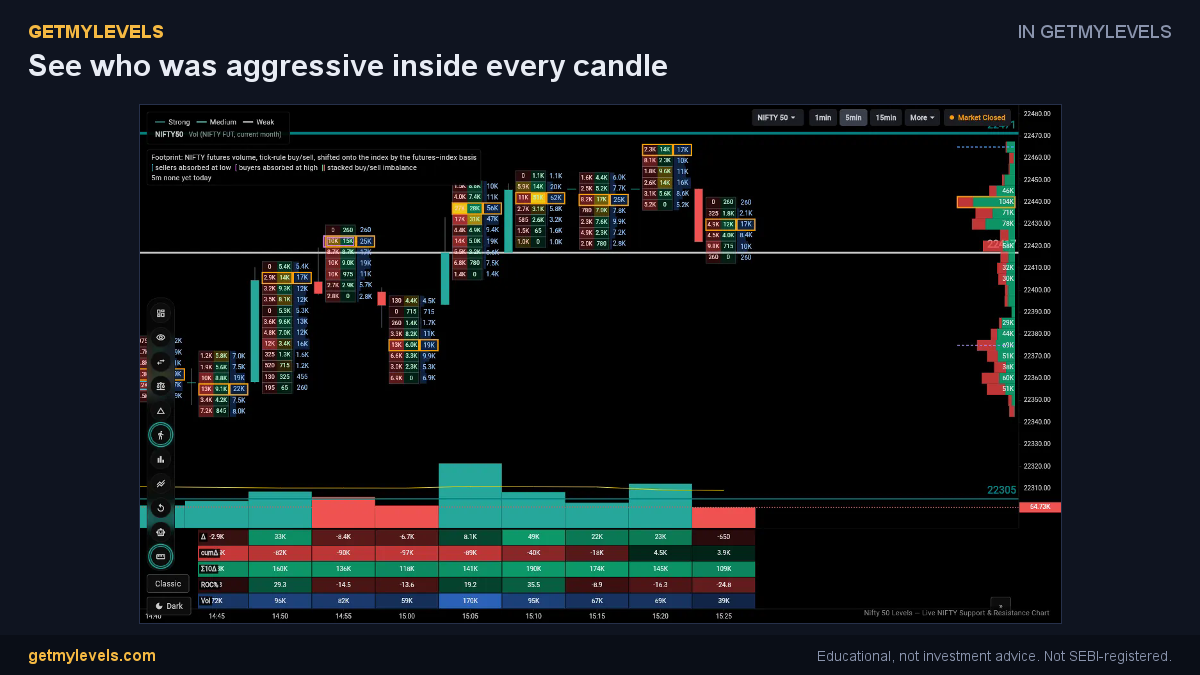 In GetMyLevels: See who was aggressive inside every candle. The live chart draws this for NIFTY, BANK NIFTY and SENSEX.
Summary
- A delta-neutral calendar spread balances the net delta to be close to zero, letting time decay be the main source of profit.
- The strike should be chosen near a support or resistance zone with high open-interest concentration.
- Payoffs are flat near the strike and rise linearly beyond it, creating a triangular shape.
- Common errors include neglecting delta, picking ill-supported strikes, or ignoring volatility changes.
- Support and resistance zones, combined with open-interest data, provide a reliable framework for selecting the strike.
With GetMyLevels, the support and resistance zones you see on the chart are live and updated in real time, giving you a clear view of the key levels to work with when setting up a calendar spread.
Written by an AI agent from GetMyLevels level data and checked by automated compliance rules. Educational, not investment advice. Not SEBI-registered.